

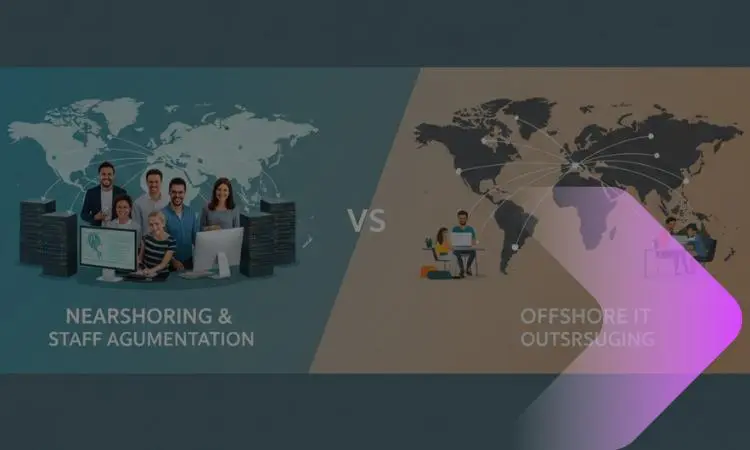
At Talently, we work daily with companies that must decide between offshore IT outsourcing and staff augmentation to scale their technology capabilities. As demand for Nearshore Tech Talent in LATAM accelerates, executives are no longer asking whether to expand their engineering teams globally — they are asking how. Understanding the structural, financial, operational, and strategic differences between these two models is critical to making the right decision for long-term growth.
In this comprehensive guide, we break down the key business differences between offshore IT outsourcing vs staff augmentation, helping organizations align their hiring strategy with scalability, control, cost efficiency, and innovation velocity.
Understanding Offshore IT Outsourcing
Offshore IT outsourcing is a business model in which a company delegates entire projects, processes, or technology functions to an external vendor located in another country. The outsourcing provider assumes responsibility for delivering results according to predefined specifications, timelines, and service-level agreements (SLAs).
In this model:
- The vendor manages recruitment, onboarding, payroll, and operations.
- The client focuses on deliverables rather than individual team members.
- Control over day-to-day execution is limited.
- Communication often follows structured reporting cycles.
Core characteristics of Offshore Outsourcing
- Project-based engagement
- Vendor-driven management
- Defined scope and contract terms
- Reduced operational oversight
- Fixed or milestone-based pricing models
Outsourcing works well for companies that require turnkey solutions without internal oversight requirements. However, it reduces flexibility when business needs evolve mid-cycle.
Understanding Staff Augmentation
Staff augmentation allows companies to extend their in-house team with external professionals while maintaining full control over workflows, management, and execution. Rather than outsourcing a project, organizations integrate remote engineers into their existing structure.
In this model:
- The client directs daily tasks and priorities.
- Engineers operate as an extension of the internal team.
- Cultural alignment and collaboration are prioritized.
- Scaling up or down is more flexible.
Core Characteristics of Staff Augmentation
- Team extension model
- Client-led management
- Flexible engagement
- Pay-per-resource pricing
- Direct collaboration with engineers
This structure is particularly powerful for companies that need to accelerate product development without relinquishing control.
Key Business differences between Offshore IT Outsourcing and Staff Augmentation
Understanding the contrast between these two models requires evaluating several strategic dimensions.
1. Control and governance
Offshore IT Outsourcing
The vendor controls execution. The client defines objectives and milestones but does not manage individual contributors directly.
Staff Augmentation
The client retains complete operational control. Engineers integrate into existing workflows, reporting structures, and performance management systems.
Business impact:
Companies prioritizing strategic oversight and agility often prefer staff augmentation.
2. Scalability and flexibility
Offshore Outsourcing
Contracts often define fixed scopes. Modifying project requirements can require renegotiation.
Staff Augmentation
Scaling talent up or down is faster. Teams can add developers, QA engineers, DevOps specialists, or data engineers based on evolving priorities.
Business impact:
High-growth companies building SaaS platforms or digital products benefit from augmentation flexibility.
3. Cost Structure and transparency
Outsourcing
Costs are often bundled into project-based pricing. Budget forecasting can be predictable but less granular.
Staff Augmentation
Pricing is transparent and tied to individual resources. Organizations pay for dedicated talent, not abstract deliverables.
Business impact:
Companies seeking cost clarity and ROI visibility often choose augmentation models.
4. Cultural alignment and communication
Outsourcing
Time zone differences and cultural gaps may impact collaboration. Communication often flows through account managers.
Staff Augmentation
Nearshore models, especially in LATAM, enable real-time collaboration. Engineers work directly with internal teams.
Business impact:
For agile product teams, seamless communication dramatically improves delivery velocity.
5. Intellectual Property and Knowledge Retention
Outsourcing
Knowledge often remains within the vendor’s structure. Transitioning providers can be complex.
Staff Augmentation
Institutional knowledge stays within the company. Engineers contribute directly to internal documentation and processes.
Business Impact:
Long-term product ownership favors staff augmentation.
When Offshore IT Outsourcing Makes Strategic Sense
While staff augmentation provides flexibility, outsourcing can be effective in specific scenarios:
- Legacy system maintenance
- One-time digital transformation projects
- Short-term proof-of-concept builds
- Non-core technology functions
Organizations seeking minimal management involvement may find outsourcing suitable for clearly defined projects.
When Staff Augmentation delivers maximum ROI
Staff augmentation becomes the superior model when companies require:
- Ongoing product development
- Agile sprint cycles
- Technical leadership integration
- Long-term platform scalability
- Rapid hiring without HR overhead
In particular, Nearshore Tech Talent in LATAM offers a competitive advantage through overlapping time zones, cultural compatibility, and strong engineering ecosystems.
Nearshore advantage: Why LATAM changes the equation
The traditional offshore model often implies distant geographies with limited real-time collaboration. However, the rise of Nearshore IT in LATAM shifts the conversation.
Key benefits of LATAM Nearshore Talent
- Time zone alignment with the US
- Strong English proficiency
- Competitive cost efficiency
- Robust STEM education systems
- Agile-friendly collaboration culture
This combination allows companies to scale with precision without sacrificing control or speed.
Risk comparison: Offshore vs Staff Augmentation
| Factor | Offshore IT Outsourcing | Staff Augmentation |
| Operational Control | Vendor-driven | Client-driven |
| Flexibility | Limited | High |
| Cost Transparency | Moderate | High |
| Knowledge Retention | Vendor-centered | Internal |
| Cultural Alignment | Variable | Strong (Nearshore) |
| Long-Term Scalability | Moderate | Excellent |
Strategic decision framework
When deciding between offshore outsourcing and staff augmentation, we recommend evaluating:
- Product Ownership Goals
- Internal Management Capacity
- Long-Term Innovation Strategy
- Required Agility
- Time-to-Market Pressure
If speed, collaboration, and long-term engineering alignment matter, staff augmentation provides structural advantages.
How we approach scalable Technology Growth
We believe technology growth must align with strategic ownership. Companies building proprietary software, platforms, or AI solutions need dedicated engineers who integrate deeply into their culture and roadmap.
This is why staff augmentation—particularly through vetted Nearshore IT models—has become the preferred solution for modern growth-stage and enterprise organizations.
Instead of outsourcing responsibility, we embed expertise.
Choosing the right model for sustainable growth
The decision between offshore IT outsourcing vs staff augmentation is not simply about cost — it is about control, scalability, intellectual property, and speed. Outsourcing works for transactional projects. Staff augmentation empowers long-term innovation.
At Talently, we specialize in connecting companies with elite Nearshore Tech Talent in LATAM that integrates seamlessly into internal teams. If you are ready to scale your engineering capacity with full operational control, explore how our Nearshore IT solutions can accelerate your roadmap and strengthen your competitive edge.