

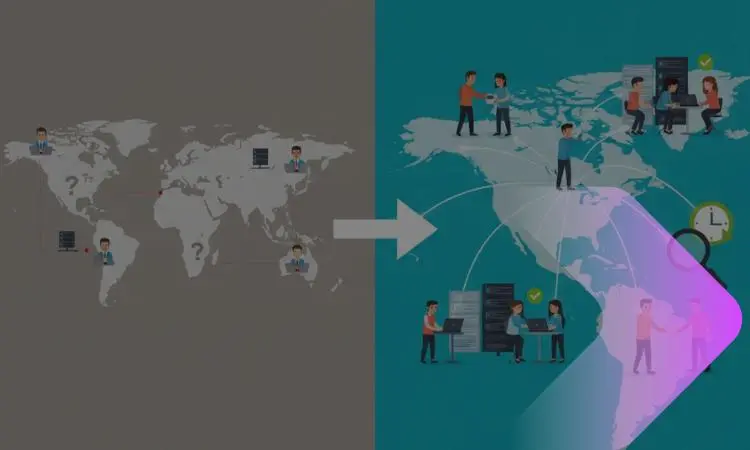
In today’s competitive digital economy, Talently has become a strategic reference point for organizations accelerating their global expansion through Nearshore IT teams in LATAM. As we analyze market shifts, hiring patterns, and operational efficiencies across North America and Europe, we see a clear trend: companies are no longer viewing nearshoring as an alternative — they are embracing it as a core pillar of their technology growth strategy.
We are witnessing a structural transformation in how companies build engineering teams. The shift toward Nearshore IT teams in Latin America is not a short-term solution; it is a long-term competitive advantage. Organizations seeking scalable, high-performing development teams are turning to LATAM for its technical expertise, time zone alignment, cultural compatibility, and cost efficiency.
The strategic evolution of Nearshore IT in LATAM
Over the past decade, global hiring models have evolved. Remote work normalized distributed teams, but companies quickly realized that location still matters. Time zones, communication speed, and collaboration efficiency directly impact delivery timelines.
By choosing Nearshore IT teams in LATAM, companies achieve:
- Real-time collaboration with US-based teams
- Faster sprint cycles and improved Agile performance
- Reduced communication friction
- Higher developer engagement and retention
Unlike offshore models in distant time zones, LATAM provides overlapping business hours with the United States, enabling daily standups, live troubleshooting, and strategic alignment without delays.
This operational proximity drives measurable gains in productivity.
Access to elite engineering talent in LATAM
Latin America has experienced a significant surge in STEM education and software engineering training. Countries such as Mexico, Brazil, Colombia, Argentina, Peru, and Chile have built robust developer ecosystems supported by universities, coding academies, and global tech companies.
Companies switching to nearshore models gain access to:
- Senior full-stack developers
- Cloud and DevOps engineers
- AI/ML specialists
- Mobile app developers
- QA automation experts
- Data engineers
These professionals are not entry-level resources. Many have experience working with US startups, Fortune 500 companies, and global SaaS platforms. Their familiarity with international standards, frameworks, and methodologies ensures seamless integration into distributed teams.
We see organizations prioritizing quality over volume, and LATAM consistently delivers highly skilled engineers who align with global performance expectations.
Cost efficiency without compromising quality
One of the strongest drivers behind the shift to Nearshore IT teams in LATAM is cost optimization. Companies are under constant pressure to scale while maintaining operational efficiency.
Hiring locally in the US or Europe often involves:
- High salary benchmarks
- Long recruitment cycles
- Intense competition for senior engineers
- Expensive benefits and overhead
Nearshoring provides competitive salary structures while maintaining high-quality output. The cost differential allows organizations to:
- Expand development capacity
- Increase runway for startups
- Invest more in product innovation
- Scale teams faster
Importantly, this is not about cutting costs at the expense of quality. It is about strategic resource allocation. Companies reduce hiring expenses while accessing equally competent, experienced professionals.
Time zone alignment
Time zone compatibility significantly impacts delivery speed and collaboration efficiency. Offshore teams operating 8–12 hours apart create lag in feedback loops, delay issue resolution, and slow sprint execution.
With Nearshore IT teams in LATAM, companies benefit from:
- Immediate Slack and Teams responses
- Same-day code reviews
- Live sprint planning
- Real-time product iteration
This proximity fosters a sense of shared ownership and accountability. Projects move faster because communication barriers are eliminated.
When speed to market defines competitive positioning, time zone alignment becomes a strategic asset.
Cultural compatibility and communication fluency
Successful distributed teams require more than technical skills. Cultural alignment and communication clarity determine whether collaboration thrives or fails.
LATAM professionals typically demonstrate:
- Strong English proficiency
- Familiarity with US business culture
- Agile methodology experience
- High adaptability to remote environments
Companies switching to nearshore models often report improved collaboration dynamics compared to offshore alternatives.
Shared work ethics, communication styles, and collaborative values accelerate trust-building between teams. This cultural synergy directly enhances productivity.
Scalability and flexibility for growing companies
Technology companies operate in cycles of rapid expansion and strategic pivots. Hiring flexibility is essential.
Nearshoring enables organizations to:
- Scale teams up or down based on roadmap demands
- Reduce recruitment timelines
- Quickly onboard specialized talent
- Adapt to changing market conditions
Startups benefit from immediate access to pre-vetted engineers, while enterprise organizations leverage nearshore teams to complement internal departments.
This scalability ensures operational resilience and growth agility.
Reduced turnover and higher retention rates
Retention remains one of the biggest challenges in the tech industry. Competitive US markets often experience frequent job switching among developers.
LATAM nearshore teams frequently demonstrate:
- Strong commitment to long-term projects
- Higher engagement levels
- Stable employment expectations
- Strong performance consistency
Reduced turnover minimizes onboarding costs, preserves institutional knowledge, and strengthens team cohesion.
Companies switching to nearshore models consistently report improved team stability.
Security, Compliance, and IP Protection
Modern nearshore providers operate under international compliance frameworks. Data security, intellectual property protection, and legal safeguards are embedded into structured agreements.
Organizations choosing Nearshore IT teams in LATAM gain:
- Secure infrastructure environments
- NDA and IP compliance
- Transparent contractual frameworks
- Clear communication protocols
Security standards now match global benchmarks, making nearshoring a reliable enterprise-grade solution.
Why the Nearshore Model Is a Long-Term Strategy
The shift toward LATAM nearshoring is not temporary. It reflects a broader transformation in global workforce distribution.
We are entering a phase where:
- Remote-first models dominate
- Distributed teams outperform centralized ones
- Talent access determines competitive advantage
Nearshore IT in LATAM aligns with these macroeconomic and technological trends. It enables organizations to build high-performance engineering ecosystems without geographic constraints.
Companies that embrace this model gain agility, scalability, and sustainable growth capacity.
Partnering with Talently for Nearshore IT Success
When organizations evaluate providers for Nearshore Tech Talent in LATAM, they require a partner that understands both technical excellence and business strategy. Talently connects companies with pre-vetted, high-performing engineers aligned with their product vision, technology stack, and growth roadmap.
Through a structured talent-matching process, streamlined onboarding, and long-term retention focus, Talently ensures that nearshore teams operate as an integrated extension of internal engineering departments.
If your company is ready to accelerate innovation, optimize hiring costs, and scale with elite LATAM engineers, explore Nearshore IT solutions today.
The competitive advantage is clear. The future of global engineering teams is nearshore — and LATAM is leading the transformation.