

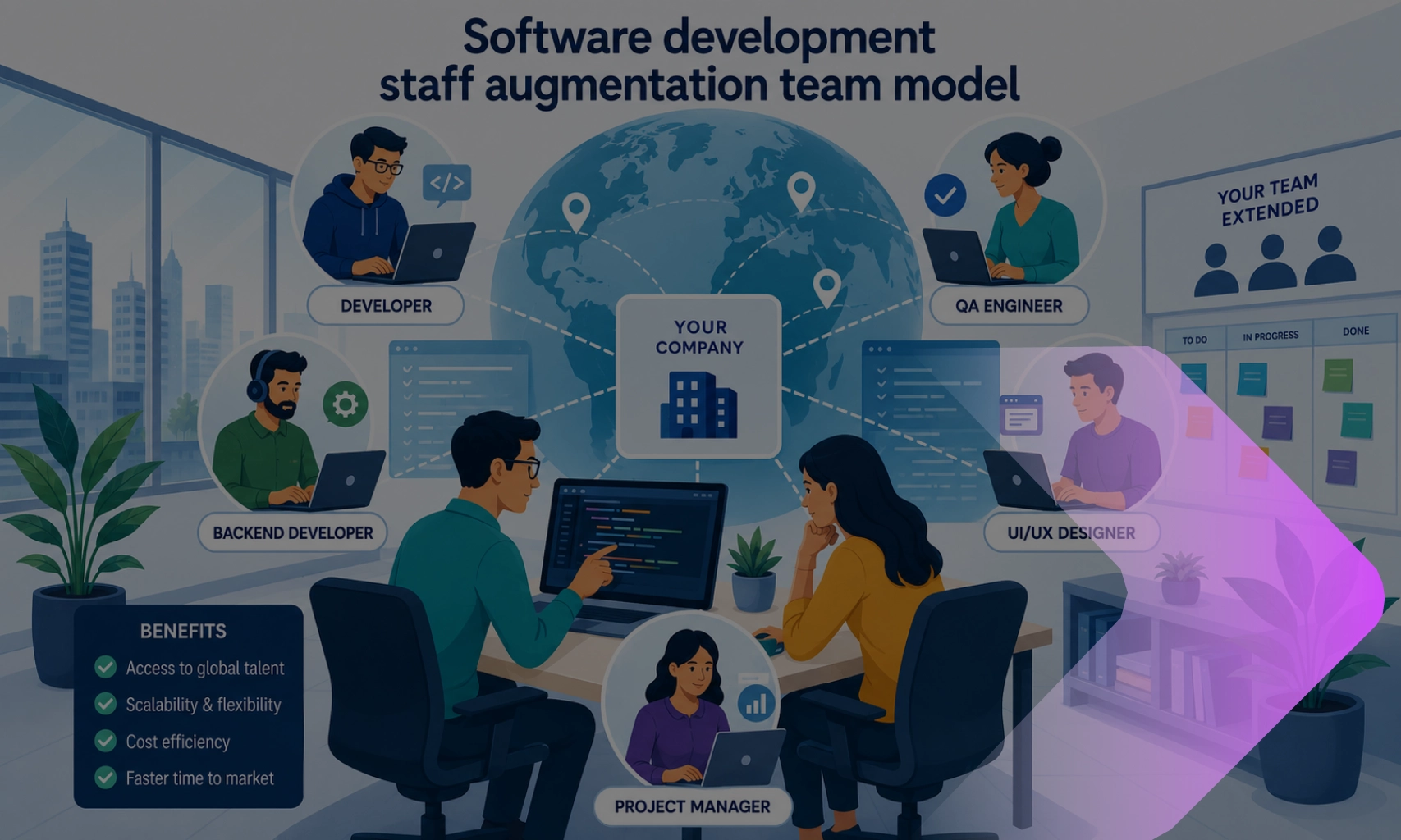
Hiring senior engineers locally takes months and costs six figures. Staff augmentation is how U.S. teams add the same seniority for a fraction of the cost. This guide is for CTOs, VPs of Engineering, and founders scaling a product team.
TL;DR
Software development staff augmentation scales your dev team by adding vetted external engineers directly to it: you define the role and manage the work, the provider sources, vets, and employs them. Unlike outsourcing a whole project, you keep the roadmap, the tools, and the standups. Sourcing in Latin America, in your time zone, cuts cost 30-70% versus U.S. hires, and every engineer is senior, pre-vetted, and bilingual.
What is software development staff augmentation?
Software development staff augmentation means bringing in outside software engineers to work as part of your in-house team for as long as you need them. Unlike traditional outsourcing (where you hand a project to an external vendor and receive a finished deliverable), augmented engineers report into your team, join your rituals, and build alongside your own developers. You direct the work; the provider is responsible for finding, vetting, and employing the talent.
Companies reach for this model when they need to fill a specific skill gap (say, a senior React or DevOps engineer), or scale a team up and down without long-term headcount risk.
How does software development staff augmentation work?
The flow runs in five steps: you define the role, the provider sends a vetted shortlist, you interview and onboard, and the provider runs the back office.
- Define the role. You specify the stack, seniority, and the outcomes you need: the same brief you’d write for a full-time hire.
- Get a vetted shortlist. The provider sources and screens candidates and sends you a short list of role-ready, pre-vetted engineers matched to your stack and seniority.
- Interview and choose. You interview the finalists exactly as you would internal candidates and pick who joins.
- Onboard into your team. The engineer integrates into your existing workflow: your repo, your board, your standups, your time zone.
- The provider handles the rest. Contracts, payroll, compliance, and IP protection sit with the provider; you get a single monthly invoice and one point of contact.
The result: you add senior engineering capacity with the flexibility of a contractor and the integration of an employee, and none of the admin.
How does staff augmentation compare to other engagement models?
The difference comes down to who manages the work and how much control you keep (you do in staff augmentation, the vendor does in project outsourcing):
| Model | Who manages the work | Best for |
|---|---|---|
| Staff augmentation | You | Filling skill gaps and scaling while keeping full control |
| Project outsourcing | The vendor | Well-defined, self-contained projects |
| Dedicated team | Mostly the vendor | Long-term parallel product work |
If you already have technical leadership in-house and want to keep control of the roadmap, staff augmentation is usually the fit. (For the full side-by-side, control, pricing models, and exactly when each model wins, see staff augmentation vs outsourcing.)
When should you use staff augmentation?
Use it when you need more skilled hands but want to keep control of how the work gets done, and skip it when you have no one in-house to direct that work.
Staff augmentation is a strong fit when you:
- Need to fill a specific skill gap (a senior backend, a DevOps engineer, an AI specialist).
- Want to scale an existing team for a roadmap push without adding permanent headcount.
- Value keeping full control of the product, code, and process.
- Have the engineering leadership in-house to direct the work day to day.
Consider project outsourcing instead when you:
- Have a self-contained project with a clear spec and no need to manage the team directly.
- Lack the internal capacity to onboard and lead additional engineers.
For most U.S. product teams that already have a tech lead and just need more skilled hands, staff augmentation is the lower-risk, higher-control choice.
Which engineering roles can you staff-augment?
Frontend, backend, and full-stack engineers, at any seniority. With a talent partner like Talently you can add pre-vetted software engineers at any level of your stack:
- Frontend developers (React, Vue, Angular)
- Backend developers (Node.js, Python, Java, .NET, Go)
- Full-stack engineers
Each profile comes matched to your stack and seniority: a senior React engineer for a product push, a Node.js specialist for an API rebuild, or a full-stack generalist to absorb backlog across the board.
(Hiring for a specific stack? Frontend developer » · Backend developer » · Fullstack developer »)
How are developers vetted?
Through three stages (AI matching, a tailored technical assessment, and human calibration), because “vetted” only means something if you can see the process. Every engineer clears all three before reaching your shortlist:
- AI matching surfaces high-signal candidates whose skills and experience fit your exact role and seniority, so you don’t wade through hundreds of résumés.
- Tailored technical assessment. Each candidate completes a custom technical evaluation aligned to your stack and level, not a generic quiz. This confirms they can actually do the work.
- Human calibration. Senior technical recruiters (reviewers with 7+ years of experience) evaluate communication skills, English fluency, and culture fit, because delivery lives or dies on how well an engineer collaborates with your team.
Only candidates who clear all three stages are presented. The result is a short list of senior, bilingual engineers who are startup-proven and culturally aligned to U.S. teams, and if a hire isn’t the right fit, a guaranteed free replacement protects you.
How much does software development staff augmentation cost?
It depends on role and seniority, but the biggest lever is where your engineers are based. Hiring senior software talent in the U.S. is expensive; sourcing the same seniority in Latin America (in your time zone) typically cuts cost by 30-70% with no drop in quality.
Here’s what hourly rates for LATAM software engineers actually look like, by role and seniority:
| Role | Junior (0-2y) | Mid (2-5y) | Senior (5y+) |
|---|---|---|---|
| Frontend Developer | $9-$13 | $13-$20 | $25-$33 |
| Backend Developer | $10-$14 | $14-$21 | $26-$36 |
| Full-Stack Developer | $12-$16 | $16-$23 | $28-$37 |
Total cost of ownership, not just salary. On top of a lower salary, the staff-augmentation model removes the overhead of local hiring: recruiting fees, benefits, payroll taxes, and HR admin. A simplified U.S.-vs-LATAM comparison for a single senior engineer:
| Typical U.S. hire | LATAM with Talently | |
|---|---|---|
| Annual salary | ~$150K | ~$72K |
| Benefits + taxes + fees | ~$55K | ~$18K |
| Total annual cost | ~$205K | ~$90K |
That’s roughly $115K saved per senior engineer, per year: money you can reinvest in more headcount or runway. (Estimate a full team with the nearshore cost calculator ».)
Why does nearshore matter for staff augmentation?
Because cost is only half the story: the other half is overlap. When your augmented engineers work in Latin America, they operate in the same or similar time zone as your U.S. team, so standups, pairing, code reviews, and quick decisions happen in real time, not on a 12-hour delay.
LATAM professionals are fluent in English and familiar with U.S. business culture; many have already worked with U.S. startups or global tech firms, so they integrate naturally. And because you’re offering U.S.-level opportunities, retention is high: over 80% of Talently hires stay longer than 12 months, which protects delivery continuity far better than high-churn offshore arrangements. (More on the model: nearshore staff augmentation ».)
How does Talently deliver staff augmentation?
Talently connects U.S. and Canadian companies with pre-vetted senior tech talent across Latin America, working remotely, full-time, and in your time zone. From a database of 100,000+ engineers and a 90% hiring success rate, you receive a shortlist of role-ready, pre-vetted candidates matched to your stack and seniority.
We handle sourcing, vetting, payroll, compliance, and IP protection, so you get one monthly invoice and none of the admin, plus guaranteed replacements if a fit isn’t right. You only pay once someone is actively working for you.
Ready to scale your engineering team? Get vetted LATAM engineers matched to your stack. Book a call »
Frequently asked questions
Will I get to interview candidates before they join?
Yes. You interview the shortlisted engineers exactly as you would internal candidates and choose who joins. The provider sources and vets, but the hiring decision is yours.
Can I hire a full team or just individual engineers?
Both. Staff augmentation lets you add one specialist to close a gap or scale an entire squad. You choose how many roles and at what seniority, and adjust as your roadmap changes.
Who handles payroll, contracts, and IP?
The provider does. Talently manages contracts, payroll, compliance, and IP protection, so you get a single monthly invoice, and guaranteed replacements if a hire isn't the right fit.
Do augmented engineers work exclusively for my team?
Yes. Augmented engineers work full-time on your team only. They are not shared across clients or split between projects. That is the practical difference from an agency retainer, where the same people rotate between accounts.
Is staff augmentation good for startups?
Yes. It lets startups scale engineering capacity without long-term headcount risk, keep control of the roadmap, and access senior talent at a fraction of local cost.